Dopamine and Motivation: Why Do We Want What We Want?
Dopamine is one of those words that gets thrown around constantly online. You often hear that dopamine is the pleasure chemical.
That is an oversimplification. Dopamine plays important roles in motivation, learning, reward, and behavior.
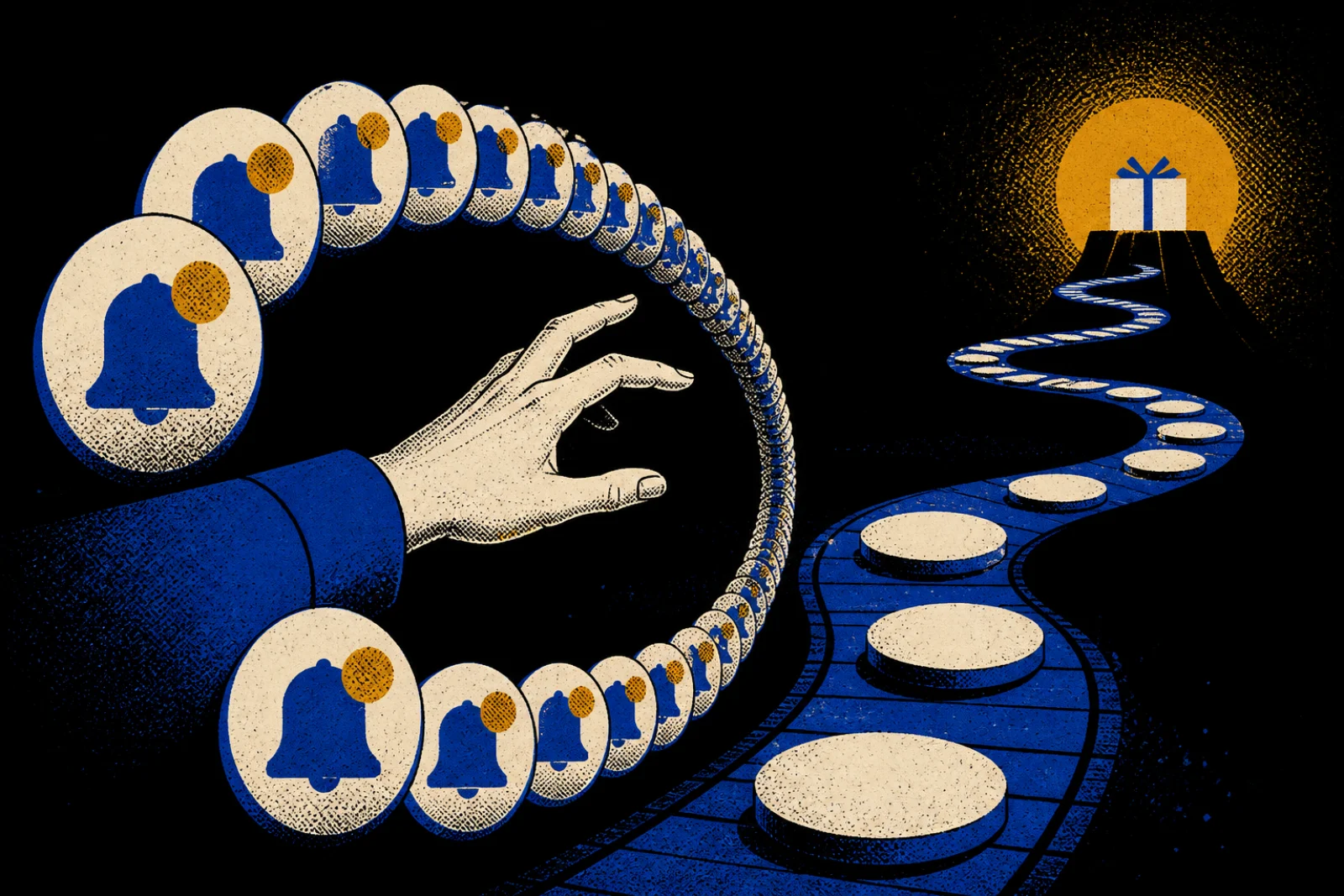
Think about your phone
You see a notification. You do not even know what the message says, but you immediately want to check it.
Your brain has learned an association: notification, possibility of something interesting, check phone.
This is part of a broader cycle:
If checking your phone repeatedly produces something interesting, your brain learns that checking can be rewarding. Eventually, even the notification sound can trigger the urge.
The interesting part: prediction
Your brain does not just react to rewards. It also makes predictions about them.
Imagine someone randomly gives you ₹1,000. You are surprised. Now imagine they promise to give you ₹1,000 every Monday. Eventually, the reward is no longer nearly as surprising because your brain expects it.
This connects to reward prediction error:
- Better than expected produces a strong learning signal.
- About what was expected produces a smaller update.
- Worse than expected produces a negative prediction error.
Your brain is constantly learning what it should expect next time.
Why some habits are difficult to stop
Compare short-form video with learning programming.
Short-form video asks for very little effort, provides an immediate reward, and delivers constant unpredictable novelty. Programming requires effort, includes frustration, and may delay visible progress for weeks or months.
It is easy to see why the first behavior can be easier to repeat. But dopamine itself is not the enemy. We need it for normal motivation and learning.
Habits are not only about willpower
Imagine the pattern: bored, open YouTube, watch something interesting, feel entertained. Eventually, boredom itself can become a cue for YouTube.
Changing a habit is not always about trying harder. You can change the environment, cue, behavior, or reward. Keeping your phone away while studying, for example, removes an easy trigger.
The practical lesson
You do not always need to wait until you feel motivated. Sometimes the process is action, progress, reward, and then more motivation.
Instead of waiting until you feel like studying, try studying for ten minutes. Start the behavior and let progress create some of the motivation.
Takeaway
Dopamine is not simply a pleasure chemical. It is part of a complex system involved in motivation, learning, reward, and behavior.
Understanding that system can help us see why certain habits become automatic and how to design our environment so better behaviors are easier.