Falsifiability: Don’t Just Ask If Something Is True
We naturally want to know whether something is true. Someone makes a claim, and our first instinct is often to ask, “Do I believe this?”
Science approaches the question differently. A more useful question is:
This idea is called falsifiability.
What is falsifiability?
A claim is falsifiable when there is some possible observation or piece of evidence that could prove the claim wrong.
For example:
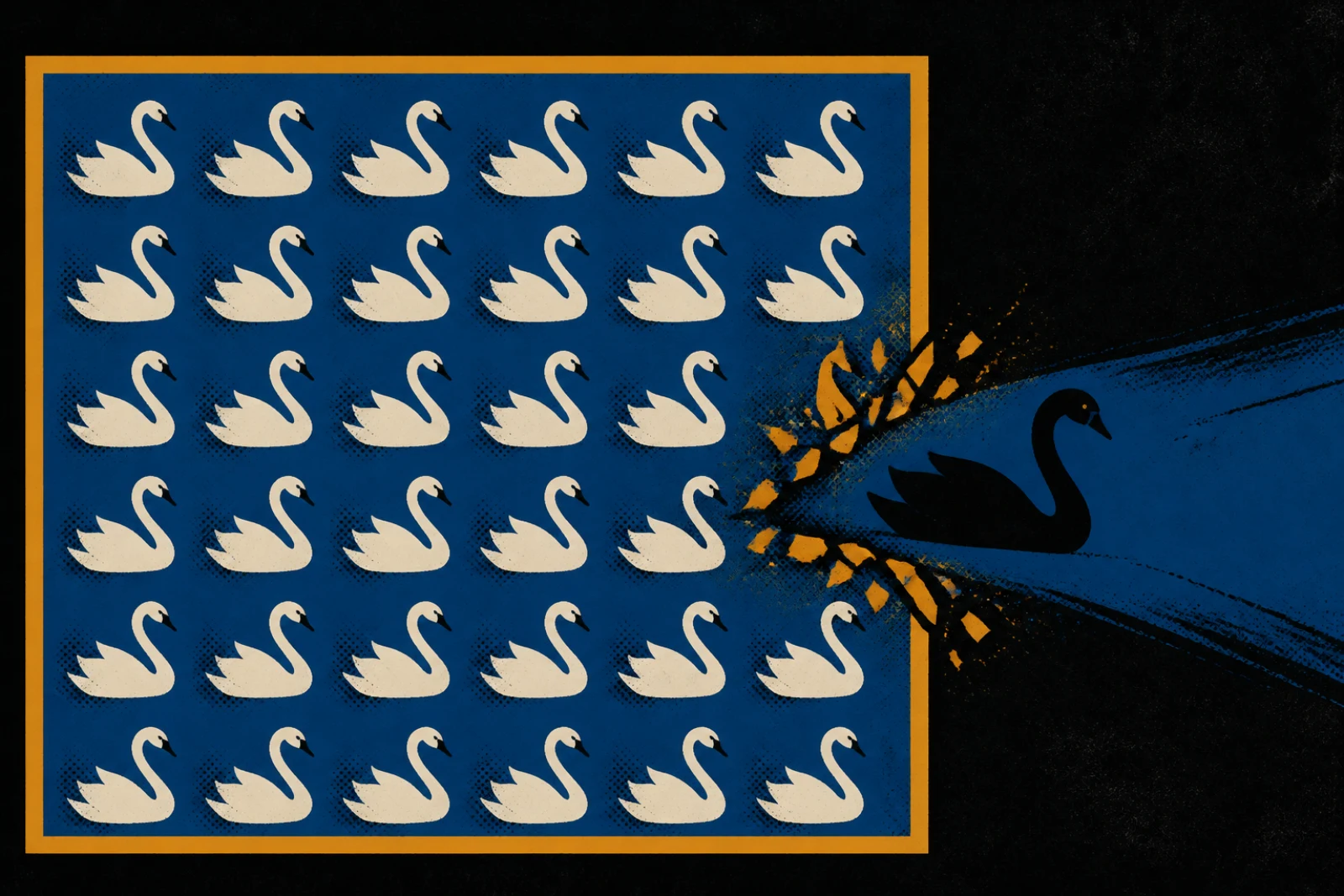
This is a falsifiable claim because finding one non-white swan would contradict it.
Now consider a statement like, “There is an invisible force controlling everything, but the force can never be detected or measured.”
If there is absolutely no possible evidence that could show the statement is wrong, then the claim is not scientifically falsifiable.
That does not automatically mean the claim is false. It means the claim is not structured in a way that allows us to test it scientifically.
Why does this matter?
Falsifiability gives us a way to distinguish between a claim that can be tested and one that cannot.
Imagine someone tells you, “This particular method will make you more productive.” Instead of immediately believing or rejecting it, you can ask:
- What does “more productive” mean?
- How would we measure it?
- What result would show that the method does not work?
- Can we actually test the claim?
Now we are moving from an opinion toward something that can be investigated.
An everyday example
Imagine your friend says, “Whenever I wear this particular shirt, I have a good day.”
You could simply believe them, or you could ask what would count as evidence against the claim. If they wear the shirt ten times and have several terrible days, that would weaken it.
But what if the person changes the claim every time something goes wrong?
“Actually, it only works when the weather is good.”
“It works even when it doesn’t seem to work.”
The claim becomes harder and harder to test. This is why clear claims matter.
Falsifiability helps you think better
The useful part of falsifiability is not limited to science. It can improve everyday decision-making too.
When you hear a strong claim, do not immediately ask, “Do I agree with this?” Instead ask, “What evidence would convince me that I am wrong?”
This question is powerful because it forces you to define what you actually believe.
Suppose someone says, “This investment is guaranteed to make money.” Instead of getting excited, ask what evidence would prove the prediction wrong. If the answer is, “Nothing. It cannot lose,” that is a major warning sign.
Real-world claims usually have conditions, uncertainty, and measurable outcomes.
Falsifiability and confirmation bias
This connects to another important idea: confirmation bias. We naturally look for information that supports what we already believe.
If I believe an idea is true, I might collect ten examples supporting it while ignoring the two examples that contradict it.
Falsifiability pushes me in the opposite direction. Instead of asking, “How can I prove myself right?”, I ask, “What could prove me wrong?”
That small change can make our reasoning much stronger.
The practical lesson
For me, the biggest lesson from falsifiability is simple:
If your idea survives serious attempts to disprove it, your confidence can become more justified. If the evidence proves you wrong, that is useful too.
Being wrong is not necessarily a failure. Refusing to update your belief when the evidence changes is the bigger problem.
Takeaway
Falsifiability teaches us to turn vague beliefs into testable claims.
Instead of asking only, “Why is this true?”, also ask, “What would show me that this is false?”
That question alone can make you think much more like a scientist and much less like someone simply defending an opinion.