Neuroplasticity: How Your Brain Changes With What You Do
We often think of the brain as something fixed. You are born with a certain brain, you grow up, and that is basically it.
But that is not quite true.
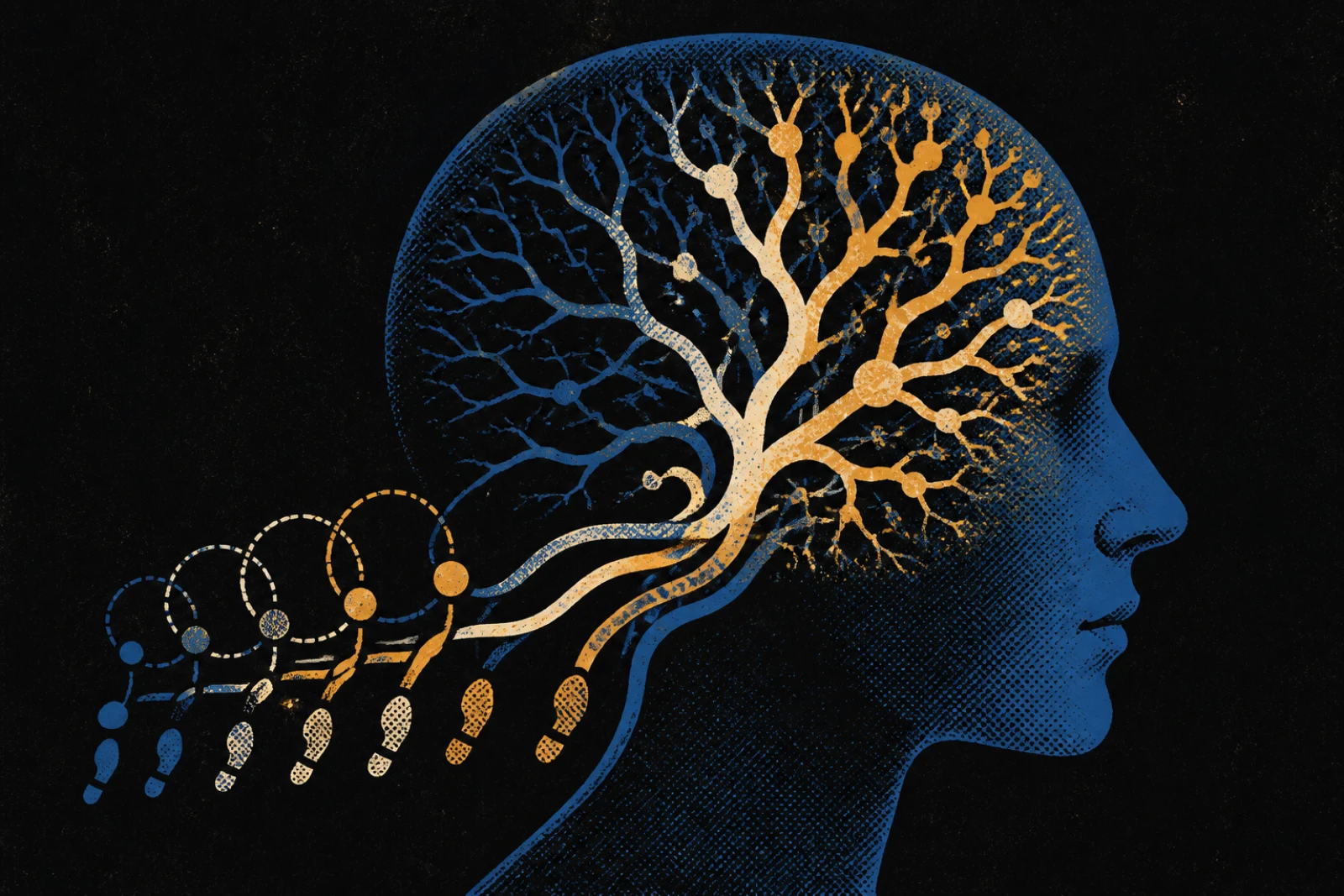
One of the most interesting things about the human brain is its ability to change, adapt, and reorganize itself. This ability is called neuroplasticity.
Every time you learn something new or repeatedly practice a skill, your brain is adapting to the activity.
Think of the brain like a muscle
A simple way to understand neuroplasticity is to compare the brain to a muscle. When you exercise a muscle repeatedly, it becomes stronger and more efficient at that particular task.
The brain works differently from a muscle, of course, but the comparison is useful: repeated use can strengthen and improve the neural pathways involved in an activity.
Imagine you start learning a new programming language. At first, everything feels difficult. You have to consciously think about syntax, concepts, and how everything fits together.
After practicing for weeks or months, many of those things become easier. You did not necessarily become smarter overnight. Your brain adapted to the activity.
Practice changes the brain
This is why repetition matters when learning. If you repeatedly perform an activity, the neural connections involved can become stronger and more efficient.
This applies to many things:
- Learning a language
- Playing an instrument
- Programming
- Solving mathematics
- Playing chess
- Developing physical skills
- Improving communication
The important part is that what you repeatedly do influences what your brain becomes better at doing.
But repetition alone is not enough
Simply repeating something does not automatically make you better. The quality of practice matters.
If you repeatedly practice something incorrectly, you can become very good at doing it incorrectly. That is why deliberate practice matters: identify what you are doing wrong, correct it, and then practice the improved version.
For example, if you are learning English and repeatedly use incorrect grammar without correcting yourself, repetition can reinforce the mistake. If you notice the mistake, understand why it is wrong, and practice the correct structure, you are giving your brain better information to learn from.
Why neuroplasticity matters in everyday life
The biggest lesson I take from neuroplasticity is that your current ability does not necessarily define your future ability.
Something that feels difficult today can become easier with consistent practice. You might currently think:
“I’m not good at mathematics.”
“I can’t understand programming.”
“I’m terrible at remembering things.”
Those statements describe your current ability, not necessarily your permanent ability. With the right practice, your brain can adapt.
Neuroplasticity does not mean you can become perfect at absolutely anything by trying hard. Genetics, environment, time, health, and many other factors matter. But it does mean that learning is a physical process of change inside the brain.
The practical lesson
This changes how I think about learning. Instead of asking, “Am I naturally good at this?”, a better question is, “What can I improve through deliberate practice?”
Every time you learn, practice, make mistakes, correct them, and try again, you give your brain an opportunity to adapt.
So the next time something feels difficult, I do not think the right conclusion is necessarily, “I’m not good at this.” It may simply mean, “My brain hasn’t built the necessary pathways yet.”
That is exactly what practice is for.
Takeaway
Neuroplasticity teaches us that the brain is adaptable. What we repeatedly learn and practice can change how our brain works.
The things you do every day are, in a sense, helping shape the brain you will have tomorrow.